English



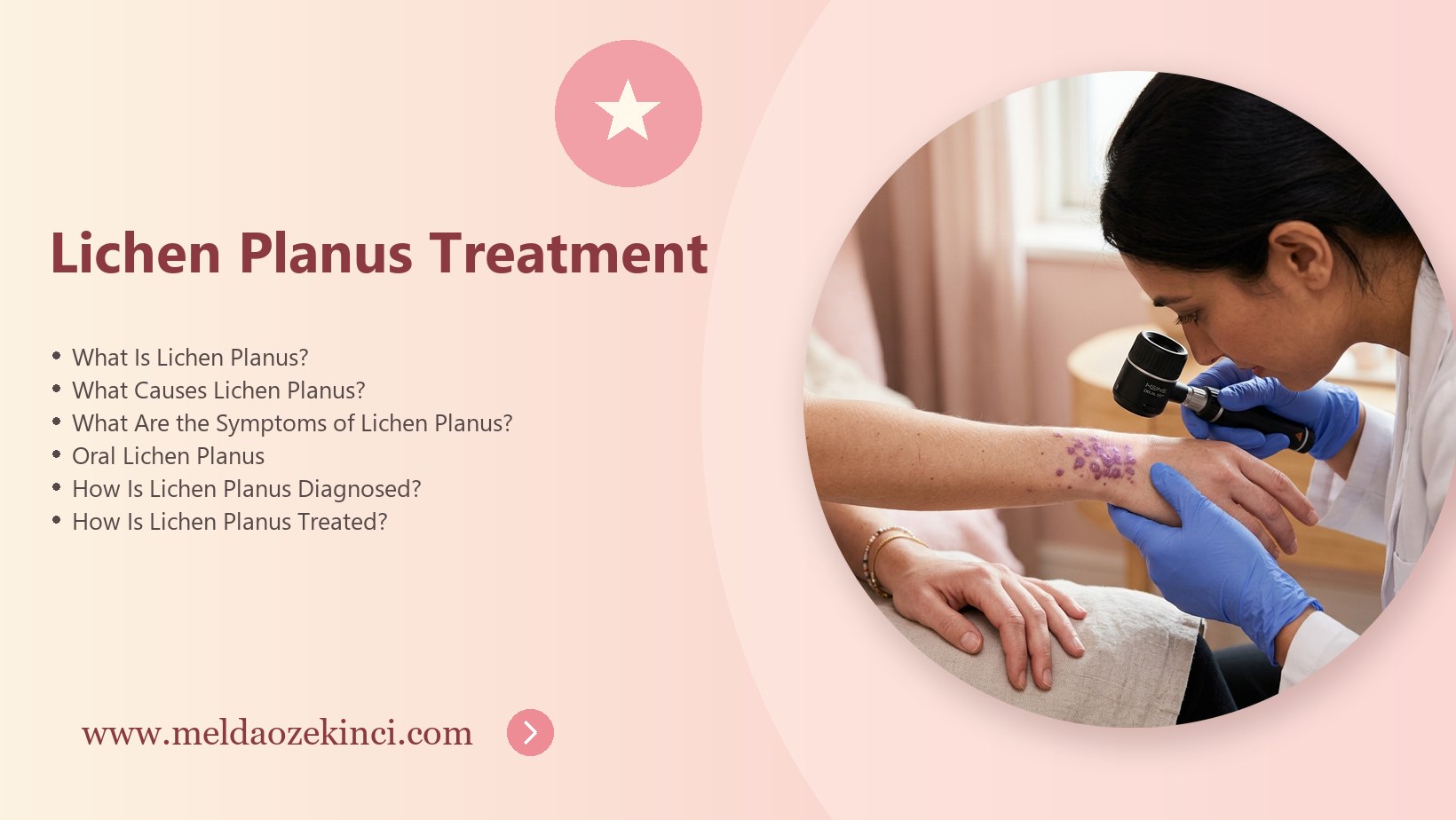

Table of Contents
- What Is Lichen Planus?
- What Causes Lichen Planus?
- What Are the Symptoms of Lichen Planus?
- Oral Lichen Planus
- How Is Lichen Planus Diagnosed?
- How Is Lichen Planus Treated?
- How Long Does Lichen Planus Last?
- Daily Life with Lichen Planus: What to Watch For
- Lichen Planus Treatment in Antalya
- Frequently Asked Questions
What Is Lichen Planus?
Lichen planus is an inflammatory, usually itchy condition that can affect the skin, the lining of the mouth, nails, scalp and genital area. It most often occurs in adults aged 30–60.
It is not contagious. Skin involvement often clears on its own within months to a few years; treatment relieves symptoms and speeds up recovery.
Lichen planus is a chronic inflammatory disease that can affect the skin, the lining of the mouth, nails, scalp and genital area. It is not contagious and is usually seen in middle-aged adults. The course of the disease and the areas it affects vary from person to person.
The disease occurs at similar rates in women and men, although oral involvement may be slightly more common in women. It is quite rare in children. Because there are different types of lichen planus, each patient's condition should be evaluated individually.
Itching is one of the most troublesome symptoms of skin lichen planus and in some patients can be severe enough to disturb sleep. Controlling itching both improves quality of life and prevents new lesions from forming due to scratching.
Genital involvement can occur in some patients and may cause itching, burning or pain. It is important not to delay discussing symptoms in this area out of embarrassment and to share them openly with the doctor for correct diagnosis and treatment.
What Causes Lichen Planus?
It is thought to result from an abnormal immune response directed at skin and mucosal cells. In most cases no specific trigger is found.
Certain medications (lichenoid drug reactions), hepatitis C infection, dental filling materials and stress are among the associated factors.
Lichen planus is thought to result from immune cells developing a reaction against cells in the skin and mucous membranes. In some patients, an association may be seen with factors such as hepatitis C infection, certain medications and some metals used in dental fillings. Periods of intense stress are also reported to trigger the disease.
Some medications can cause lichenoid drug reactions that closely resemble lichen planus. For this reason, the doctor asks in detail about medicines the patient has recently started. When a drug is suspected, changing it should be evaluated together with the prescribing doctor.
Stress is thought to play a role in the onset and flare-ups of the disease. Paying attention to stress management, getting regular sleep and adopting a balanced lifestyle during treatment contribute to skin health as well as general health.
It is helpful for patients diagnosed with lichen planus to mention this diagnosis when visiting other doctors. Especially when a new medicine is to be started or dental treatment is planned, knowledge of the disease allows possible triggers to be assessed in advance.
What Are the Symptoms of Lichen Planus?
On the skin, it typically appears as small, purple-pink, flat-topped, shiny, polygonal bumps. Fine white lines (Wickham’s striae) may be seen on their surface. The inner wrists, forearms, legs and lower back are most often affected.
Itching can be marked. New lesions may appear in a line along scratches or areas of trauma. Thinning and ridging of the nails, and a scalp form that can cause permanent hair loss, may also occur.
The most typical skin appearance is purple-red, flat-topped, angular and usually itchy bumps. These lesions most often appear on the inner wrists, ankles, legs and lower back. Fine white lines may be noticed on the surface of the lesions.
When lichen planus affects the nails, thinning, lengthwise ridges, breakage and in some cases nail loss may occur. Scalp involvement can lead to a condition that causes permanent hair loss. It is therefore important to show nail and hair changes to a doctor early.
Dark marks left after lesions heal may be more prominent and longer-lasting, especially in people with darker skin. These marks are generally harmless and fade over time. Sun protection plays an important role in preventing them from darkening further.
Oral Lichen Planus
In the mouth, it appears as lacy white lines on the inner cheeks and is usually painless. The erosive form causes burning, pain and sensitivity to spicy foods.
Long-standing erosive oral lichen planus carries a small risk of malignant change, so regular follow-up with a dermatologist and dentist is important.
Oral lichen planus most often appears as white, lace-like lines on the inside of the cheeks, tongue and gums. It causes no symptoms in some patients, while others may experience burning, sensitivity and open sores. These lesions can cause marked discomfort with spicy or acidic foods.
Patients with oral lichen planus should have regular dental check-ups and pay attention to oral hygiene. Regular follow-up of long-standing lesions, especially the erosive type, allows changes in the lesions to be noticed early.
Oral lichen planus may sometimes appear only as redness and peeling of the gums and can be confused with gum disease. It is helpful for a dermatologist and a dentist to work together to evaluate burning and bleeding when brushing the teeth.
How Is Lichen Planus Diagnosed?
Diagnosis is usually based on the clinical appearance and dermoscopic findings. In doubtful cases it is confirmed by skin biopsy.
Your doctor may request blood tests such as hepatitis C screening and will review the medications you use.
Diagnosis is often made by dermatological examination based on the typical appearance of the lesions. However, a biopsy may be performed by taking a small tissue sample to distinguish it from similar-looking diseases or to confirm the diagnosis. When necessary, blood tests may also be requested for associated conditions such as hepatitis.
A biopsy is a simple procedure that is usually done quickly under local anesthesia on an outpatient basis. Pathological examination of the tissue sample helps confirm the diagnosis and plan treatment correctly. The results are reviewed by the doctor together with the patient.
During the examination, it is important to check not only the area of concern but also other areas the disease may affect, such as the mouth, nails, scalp and genital area. Some patients may not have noticed changes in these areas.
How Is Lichen Planus Treated?
First-line treatment includes potent topical corticosteroids and topical calcineurin inhibitors. Antihistamines can help with itching.
For widespread or resistant cases, options such as narrowband UVB phototherapy, short courses of systemic corticosteroids or retinoids may be planned after medical evaluation. Special oral preparations are used for the mouth form.
The aims of treatment are to reduce itching and inflammation, speed healing of lesions and minimize possible lasting marks. For lesions in limited areas, anti-inflammatory creams are often the first choice, and supportive medicines may be used for itching. In widespread cases, phototherapy or other treatment options may be considered.
Response to treatment varies from person to person, and in some patients the treatment plan may need to be updated over time. Using creams for the duration and frequency recommended by the doctor is important to prevent unwanted effects. Stopping treatment abruptly may cause symptoms to worsen.
Phototherapy may be considered as an option especially for skin lichen planus that affects large areas of the body and cannot be controlled with creams. Sessions are given according to a set schedule under medical supervision, and the effect of treatment is monitored regularly.
How Long Does Lichen Planus Last?
In most patients, skin lesions clear within 1–2 years; however, brown marks (post-inflammatory hyperpigmentation) may remain for a while. Oral and nail involvement can last longer.
The condition rarely recurs; a check-up is recommended if new lesions appear.
In many patients, skin lichen planus resolves within one to two years, either on its own or with treatment. However, brown marks may remain on the skin for a while after the lesions heal; these also fade over time. Oral lichen planus generally follows a longer and more persistent course.
During the course of the disease, there may be periods of flare-ups and quieter periods. This can be wearing for patients, but with regular follow-up, flare-ups are noticed earlier and controlled more easily. Knowing how the disease progresses helps patients keep their expectations realistic.
Photographing the lesions at regular intervals during treatment helps assess improvement more objectively. In slowly progressing healing, these photos provide concrete evidence of the treatment's effect for both the patient and the doctor.
Daily Life with Lichen Planus: What to Watch For
Avoid scratching, cleanse the skin with gentle products and moisturize regularly. With oral involvement, good oral hygiene and avoiding smoking, alcohol and very spicy or acidic foods reduce symptoms.
Sun protection prevents the remaining marks from darkening after healing.
In daily life, it is important not to scratch the lesions, to avoid harsh soaps and products that irritate the skin, and to moisturize regularly. New lesions are known to appear in areas of skin exposed to trauma. Protecting the skin from friction and injury is therefore helpful.
Patients with oral lesions may reduce symptoms by avoiding very hot, spicy, acidic and hard foods. Since smoking and alcohol are known to irritate the oral mucosa, quitting these habits is also recommended. A soft toothbrush and toothpaste suitable for sensitive mouths can be preferred.
Choosing loose, cotton clothing that does not press on the skin reduces irritation from friction. Since sweating in hot weather can increase itching, staying in cool environments and rinsing the skin with lukewarm water after sweating can provide relief.
Lichen Planus Treatment in Antalya
Because lichen planus can affect several areas, it requires a thorough examination and regular follow-up. In the consultation with dermatologist Dr. Melda Özekinci, the skin, mucosa, nails and scalp are evaluated and treatment is planned according to your symptoms.
For lichen planus treatment in Antalya, it is important that the dermatologist can evaluate skin and oral involvement together and collaborate with dentists and other specialists when necessary. In a hot, sunny climate, protecting the skin from the sun should also be considered so that marks left after healing do not become more prominent.
A doctor-patient relationship in which the patient can ask questions freely and is monitored with regular check-ups positively affects treatment success. As lichen planus may require long-term follow-up, it is important for the patient to be treated at a clinic where they feel safe.
Having accurate information about the disease helps reduce unnecessary worry. Knowing that lichen planus is not contagious, that it can be controlled in most patients and that it can be managed safely with regular follow-up helps patients approach the process more positively.
Frequently Asked Questions
Is lichen planus contagious?
No, it is not contagious.
Does lichen planus go away on its own?
Skin involvement often fades over time; treatment shortens the course and reduces itching.
Does lichen planus leave marks?
It may leave brown marks, which usually fade over time.
Is lichen planus cancer?
No. However, long-standing erosive oral forms require follow-up.