 English




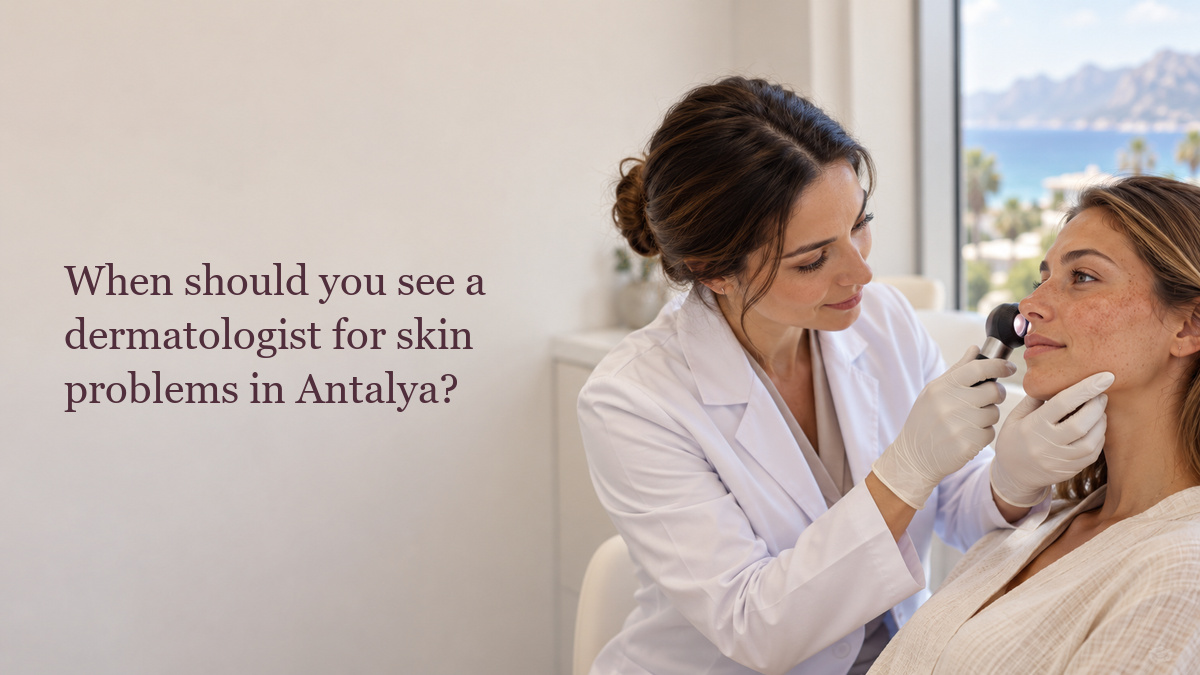
Table of Contents
- When Should You See a Dermatologist for Skin Problems?
- Which Skin Symptoms Require Urgent Attention?
- When Should You Apply for Changes in Moles and Spots?
- When Should You Apply for Itching and Rashes?
- When Should You Apply for Acne and Pimple Problems?
- When Should You Apply for Hair Loss and Scalp Problems?
- When Should You Apply for Nail Changes?
- When Should You Apply for Wounds, Blisters and Signs of Infection?
- When Should You See a Dermatologist for Aesthetic Concerns?
- What Preparations Are Useful Before Going to the Dermatologist?
- What Is Done at a Dermatologist's Examination?
- Why Is Sun-Related Skin Checking Important for Antalya Residents?
- What Should Be Considered When Choosing a Dermatologist?
- When Should You Apply for Skin Problems in Pregnancy and Breastfeeding?
- When Should You Apply for Skin Problems in Children?
- Which Groups Are Recommended to Have a Skin Check Once a Year?
- Frequently Asked Questions
When Should You See a Dermatologist for Skin Problems?
Most skin, hair and nail problems are harmless and temporary; however, some can be the first sign of a serious disease. If your complaint has not improved for several weeks, is getting worse quickly, or affects your daily life, sleep or mood, that is reason enough for a dermatologist's examination.
If you are not sure when to apply, an early examination is often the safest option. Early diagnosis prevents permanent scarring and complications in many skin diseases.
Which Skin Symptoms Require Urgent Attention?
Symptoms such as widespread redness and peeling, a spreading rash with fever, painful blisters, involvement of mucous membranes (mouth, eyes, genitals), a serious rash after starting a medication, facial swelling and shortness of breath are emergencies. In these cases, go to the emergency department or the nearest health facility without waiting.
Painful, rapidly spreading redness, warmth and fever may be a sign of a skin infection (cellulitis) and require urgent treatment. Do not try to wait these symptoms out at home.
When Should You Apply for Changes in Moles and Spots?
Moles and spots that are new, growing quickly, changing color, becoming irregular at the borders, bleeding, crusting or not healing should be evaluated for skin cancer. The "ABCDE" rule (asymmetry, border irregularity, color variation, diameter, evolution) is a guide.
People with many moles, those with a family history of skin cancer and those who frequently get sunburned should have a skin check once a year.
When Should You Apply for Itching and Rashes?
Mild itching lasting a few days is sometimes related to dryness or allergy; however, itching that is severe, disturbs sleep at night, is widespread or lasts for weeks must be evaluated. Do not wait if redness, scaling, blisters or oozing accompany it.
Itching can sometimes be a sign of internal diseases (liver, kidney, thyroid). Itching of unclear cause may therefore require general tests.
When Should You Apply for Acne and Pimple Problems?
A dermatologist should be consulted if pimples are widespread, painful, cystic or leave scars; if they do not improve despite a few weeks of regular care; if they started suddenly in adulthood; or if irregular periods or excessive hair growth accompany them.
Early treatment markedly reduces permanent acne scars. Squeezing pimples and trying unsourced products can make the situation worse.
When Should You Apply for Hair Loss and Scalp Problems?
A dermatologist's examination is needed if there is a marked increase in daily hair loss, a receding hairline, round patches of hair loss, or itching, scaling or redness on the scalp. Hair loss can be caused by iron deficiency, thyroid disease, a hormonal disorder, stress or a skin disease.
Procedures started without a correct diagnosis can waste time. Some hair loss leaves scars and early treatment is important.
When Should You Apply for Nail Changes?
An evaluation is needed if there is color change, thickening, pitting or brittleness of the nails, a line or dark spot under the nail, separation of the nail from the bed, and swelling or pus around the nail. A dark line under the nail can rarely be a sign of melanoma.
Nail fungus, psoriasis and an ingrown nail can look similar; wrong treatment delays recovery. For diagnosis, an examination and, if needed, a laboratory test are done.
When Should You Apply for Wounds, Blisters and Signs of Infection?
A wound that has not healed for two to three weeks, a lesion that bleeds or crusts repeatedly, groups of painful blisters (suspected shingles or cold sores), pus, yellow crusting and spreading redness require a doctor's examination.
With shingles symptoms (a one-sided painful blistering rash), starting treatment in the first days reduces complications; it is important not to wait.
When Should You See a Dermatologist for Aesthetic Concerns?
For your aesthetic concerns such as spots, wrinkles, scars, excess hair or skin texture, having an examination first is right for safety. Because some spots or bumps can be a medical problem and a diagnosis should be made before aesthetic procedures.
Risks, expectations and alternatives should be discussed with the doctor before procedures.
What Preparations Are Useful Before Going to the Dermatologist?
Note when the complaint started, how it progressed, the medications and products you use, illnesses you have had, skin diseases in the family and your allergies. Earlier photos of the lesion can help the diagnosis. Coming without makeup makes the skin examination easier.
Not applying new products or creams to the area before the appointment preserves the true appearance of the lesion.
What Is Done at a Dermatologist's Examination?
The doctor listens to your history and examines your skin, hair and nails. Dermoscopy is performed if needed; in addition, scrapings, cultures, blood tests or a biopsy may be requested. After the diagnosis, a treatment plan and follow-up program are created.
Do not hesitate to ask about points you do not understand during the examination. Getting treatment instructions in writing makes application easier.
Why Is Sun-Related Skin Checking Important for Antalya Residents?
Because sun exposure is high in Antalya, the risk of sun-related spots, premature aging and skin cancer may increase. People who work outdoors, swim often and are fair-skinned should have regular skin checks.
Using sunscreen every day, preferring a hat and protective clothing, and noticing new spots early are the basic ways of protection.
What Should Be Considered When Choosing a Dermatologist?
It is important that the doctor's specialty certificate and the license of the institution where they work can be verified from official records, that they give you enough time and that they clearly explain diagnosis and treatment options. Avoid exaggerated promises and "definite solution" statements.
Your complaint is carefully evaluated in the examination by Dermatologist Specialist Dr. Melda Özekinci and a diagnosis and treatment plan suited to you are created. You can visit our contact page for information.
When Should You Apply for Skin Problems in Pregnancy and Breastfeeding?
Hormonal changes in pregnancy can cause melasma, stretch marks, acne and itching. Most are harmless; however, severe, widespread itching (especially on the palms and soles) can be a sign of a liver-related condition and requires urgent evaluation. Products and medications used in pregnancy should not be chosen without a doctor's advice.
During breastfeeding too, the medications and topical products to be used should be evaluated with a doctor.
When Should You Apply for Skin Problems in Children?
Eczema, cold sores, warts, molluscum, lice, fungus and birthmarks are common in children. If there is a rash with fever, widespread blisters, a quickly growing birthmark, a bleeding lesion or signs of infection accompanying eczema, a pediatrician or dermatologist should be consulted without delay.
It is important that parents do not use cortisone or antibiotics on their own.
Which Groups Are Recommended to Have a Skin Check Once a Year?
People with many moles, those with a family history of melanoma, those who have had skin cancer in the past, those using immunosuppressive drugs, those who frequently get sunburned and fair-skinned people should have regular skin checks. This check increases the chance of early diagnosis.
Frequently Asked Questions
What diseases does a dermatologist treat?
A dermatologist treats skin, hair and nail diseases and some sexually transmitted skin infections; they also carry out aesthetic dermatology procedures.
Do I need to see a dermatologist for every mole?
No. However, moles that change, grow, bleed or look suspicious must be evaluated. An annual check is recommended for people with many moles.
Should I go to the pharmacy first for a skin problem?
For mild and short-term problems the pharmacist can guide you; however, if the complaint does not go away or gets worse, a dermatologist should be consulted.
Is a dermatologist's examination painful?
It is usually painless. Procedures such as a biopsy are done under local anesthesia.
Should I go to the appointment wearing makeup?
Coming without makeup allows the skin to be examined better.





