English


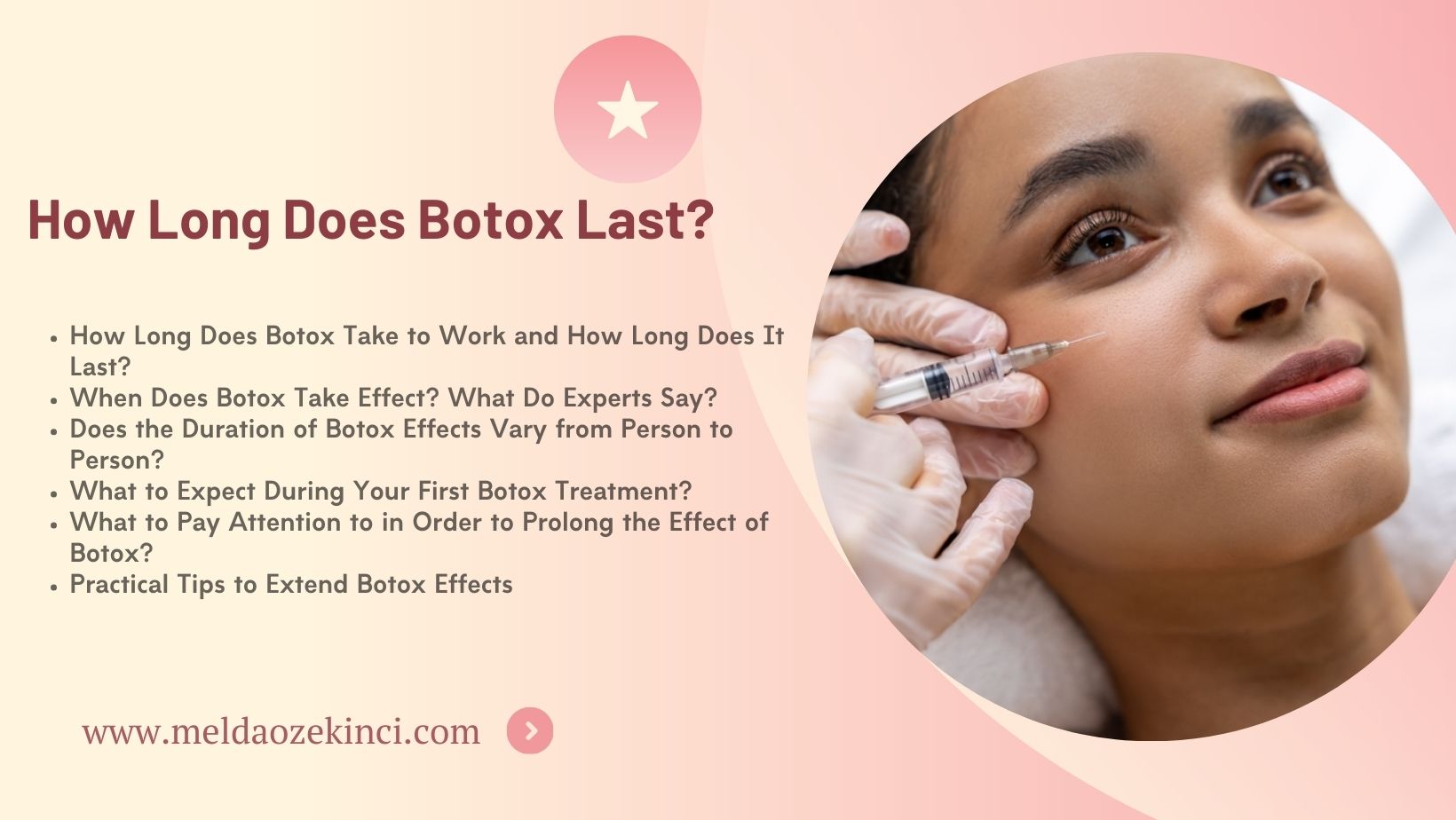

Table of Contents
- How Long Does Botox Last?
- When Does Botox Start to Work?
- What Factors Determine How Long Botox Lasts?
- What Should Be Expected at a First Botox Treatment?
- In Which Areas Is Botox Applied?
- What Can Be Done to Prolong the Effect of Botox?
- What Should Be Considered After Botox?
- What Are the Side Effects and Risks of Botox?
- Who Is Botox Not Suitable For?
- What Is the Difference Between Botox and Filler?
- Is the Botox Procedure Painful?
- What Happens When the Effect of Botox Wears Off?
- How Should You Prepare Before a Botox Treatment?
- How Do You Choose the Right Doctor for Botox in Antalya?
- Why Is the Botox Follow-Up Appointment Important?
- How Are Dose and Product Chosen in Botox Treatment?
- What Are Common Wrong Expectations About Botox?
- Frequently Asked Questions
How Long Does Botox Last?
The effect of botulinum toxin (botox) is temporary. In most people the effect lasts 3 to 6 months on average; this period may be shorter or longer depending on the person, the area treated and the dose. Over time the muscles start moving again and expression lines become visible again. When the effect wears off, the result returns to its former state on its own; there is no permanent change.
The figures given for duration are averages. Promising an exact duration is not correct. Even in the same person, the duration may differ in different areas.
When Does Botox Start to Work?
The effect usually starts 3-7 days after the procedure and reaches its full effect in about 10-14 days. The effect, which is not noticeable in the first days, appears gradually as the muscles slowly relax. It is therefore necessary to wait at least two weeks to evaluate the result.
If there is anything missing or asymmetry after two weeks, the doctor can do a small additional application at the check-up. It is therefore important to attend the follow-up appointment.
What Factors Determine How Long Botox Lasts?
Muscle strength and mass, the dose applied, the type of product, the area treated, the person's metabolism, the intensity of facial expressions and lifestyle habits such as exercise affect the duration of effect. In people with strong muscles or heavy use of facial expressions, the effect may last a shorter time.
In the first treatments the duration of effect may be shorter; with regular treatments the duration may increase in some people. However, this is not a definite rule.
What Should Be Expected at a First Botox Treatment?
At the first examination the doctor examines your facial muscles while you make expressions, listens to your goal and makes the treatment plan. The procedure usually takes 10-20 minutes and is done with very fine needles at determined points. Most people describe a mild stinging sensation.
After the procedure, small redness and bumps go away within a few hours. For a natural result a low dose is preferred in the first treatment and completed at the check-up if needed.
In Which Areas Is Botox Applied?
It is most often used for forehead lines, glabellar (between the brows) lines and crow's feet around the eyes. It can also be applied to the chin tip, neck bands and the masseter (chewing muscle) area. It is also used in the treatment of excessive sweating.
The dose, technique and duration of effect differ in each area. It is important that the procedure is done in a way that preserves the face's natural expression.
What Can Be Done to Prolong the Effect of Botox?
There is no proven method that directly extends the duration of botox; however, protecting from the sun, avoiding smoking, eating a balanced diet, getting enough sleep and keeping the skin moisturized support overall results. Following the care rules recommended by the doctor in the first days is important.
When the effect wears off, planning the next treatment before the lines deepen may require a lower dose in some people. This decision should be made together with the doctor.
What Should Be Considered After Botox?
It is recommended not to lie face down for the first 4 hours, not to massage or press on the area for the first 24 hours, and to avoid intense exercise, sauna and steam baths. Making gentle facial movements in the first hours may help the effect settle. Makeup can usually be worn after a few hours.
If pain, fever, marked swelling, eyelid drooping or vision change occurs, a doctor should be consulted. These situations are rare.
What Are the Side Effects and Risks of Botox?
The most common are mild pain, redness, bruising and headache at the injection site. More rarely, asymmetry, brow or eyelid drooping, changes in the smile and allergic reaction may be seen. These effects are temporary and resolve when the product's effect wears off.
To reduce risk, the procedure should be performed by an authorized physician who knows anatomy well, with a licensed product.
Who Is Botox Not Suitable For?
Pregnancy and breastfeeding, allergy to botulinum toxin or its ingredients, infection in the treatment area, neuromuscular diseases such as myasthenia gravis and the use of some drugs (for example aminoglycoside antibiotics) are situations in which botox is not suitable.
The procedure is also not suitable for people with unrealistic expectations. Telling the doctor your health history completely is necessary for your safety.
What Is the Difference Between Botox and Filler?
Botox softens expression lines by reducing muscle movement. Filler fills volume loss and folds. If the cause of the line is muscle movement, botox may be more suitable; if it is volume loss, filler; in some cases the two are used together.
Which method is suitable is determined after the examination. For treatment options for wrinkles, you can look at our wrinkle treatment page.
Is the Botox Procedure Painful?
Because very fine needles are used, most people find the procedure mildly uncomfortable. If needed, a numbing cream or ice can be applied before the procedure. Pain threshold varies from person to person.
Long-lasting pain is not expected after the procedure; if there is severe pain, a doctor should be consulted.
What Happens When the Effect of Botox Wears Off?
When the effect wears off, the muscles return to their normal movement and the lines return to their former state. Botox does not cause permanent damage to the muscles; if the treatment is not repeated, the result returns to its former state on its own.
With regular treatments, in some people the duration of effect may increase because of reduced muscle activity. However, this does not apply to everyone.
How Should You Prepare Before a Botox Treatment?
In the days before the procedure, the doctor should be told that aspirin, blood thinners and some supplements may increase the risk of bruising. It is recommended to avoid alcohol the day before and to have the procedure at least two weeks before an important event.
Coming to the procedure without makeup allows the application to be done more comfortably.
How Do You Choose the Right Doctor for Botox in Antalya?
Make sure the procedure is performed by an authorized physician, with a licensed product and under sterile conditions. It is your right to see the brand and packaging of the product used. Avoid exaggerated promises and very low prices.
In the examination by Dermatologist Specialist Dr. Melda Özekinci, the expression muscles are evaluated; whether botox is suitable for you and what the right dose will be are determined individually. You can visit our contact page for information.
Why Is the Botox Follow-Up Appointment Important?
The check-up done about two weeks after the procedure is needed to assess whether the effect has fully appeared. At this appointment, situations such as asymmetry, insufficient effect or excessive relaxation are reviewed and a small correction is made if needed.
The check-up also provides an opportunity to determine the timing and dose of the next treatment.
How Are Dose and Product Chosen in Botox Treatment?
The dose is determined according to muscle strength, the area, gender and the goal. In men the dose may differ because muscles are generally stronger. The units of different botulinum toxin products are not directly equivalent to each other; care should therefore be taken when comparing products and doses.
It is important for safety that the product is licensed, that its packaging is opened in front of you and that the product information is recorded.
What Are Common Wrong Expectations About Botox?
Expectations such as "if I have it once it will be permanent", "it stops aging" or "it erases all wrinkles" are not correct. Botox is especially effective for expression lines; other methods may be needed for deep folds, volume loss and sagging.
Frequently Asked Questions
When does botox start to work?
It usually starts within 3-7 days and reaches its full effect in 10-14 days.
How many months does botox last?
It lasts 3-6 months on average; it varies with the person and the area.
Does botox make the face expressionless?
When done in the right dose and with the right technique, the natural expression is preserved. Excess dose can lead to a lack of expression.
Is botox permanent?
No. Its effect is temporary and fades over time.
Can botox be done during pregnancy?
No. It is not done during pregnancy and breastfeeding.